
 Sign in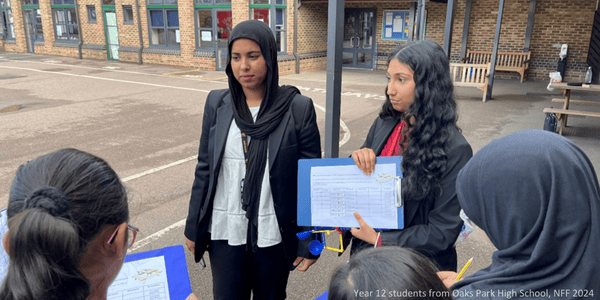
28 January 2025
Read time: 4mins
‘It is also important at least once for pupils to experience a different side to the place they know well.’
Paula Richardson
How are you getting along with setting up your fieldwork? Sometimes the organising of it can take longer than the actual visit but don’t give up! We all know the benefits of going out and having the chance to see the real world for ourselves and pupils not only learn a lot about the place but also enjoy the experience of being outside.
Fieldwork is using the outdoor experience to test out ideas, investigate issues and help pupils understand more about how the world around them ticks. Exposure to social media, TV and advertising may extend their awareness of other places but they often remain uncritical, unobservant and lacking in personal experience. That’s where fieldwork comes in.
Fieldwork gives them the opportunity to see a place they probably visit frequently, through fresh eyes, which allows them to investigate, discuss, and understand more about why things are as they are. Both the school grounds and local area can provide a wealth of opportunities for investigating and developing their own enquiries.
You may feel your own area is not interesting or too difficult to engage their interest. However everywhere has interesting aspects – have you thought about looking at the street art or graffiti, or the geology of the area. I don’t know anything about geology in my area you say, but wait – what about this list?
- granite: kerbstones, road surfaces, gravel, walls, bridges, monuments
- limestone: concrete paving slabs, statues, carvings (on churches), housing, wall blocks
- slate: roofing tiles and sometimes cladding on a house
- sandstone: walls, statues, houses
- sand: driveways – used as a major constituent of concrete
- flints: walls, decoration on houses
- limestone: flooring, some buildings, pavements, steps
- marble (metamorphic rock): columns, steps, flooring, decoration on buildings
- clay: bricks.
There may be transport links, car parks and traffic issues – everywhere has parking problems! It would be helpful to not only to look at the problems but identify how they are being tackled. Traffic control can include traffic lights, roundabouts, one-way streets, or speed reduction such as speed humps and chicanes. Can these be mapped around the area? Do they cause congestion or help free flow? Many residential areas have a 20miles an hour speed limit – is this helpful? What do local people think about it?
Think about different sites or locations which may be in your area. Besides local shops, parks, water features and local recreation facilities, places such an industrial estate, a new building site or the sewage farm might provide rewarding experiences. Housing developments are found everywhere and watching these grow over time will provide a historical record as well as a geographical location. Ask the developers if the pupils can visit safely and perhaps have a short talk given by the site manager. If you don’t ask…!
Many schools are located near or on housing estates which at first glance may look to be unrewarding as a place to investigate. However, people like to personalise their houses and put their own mark on their property. How do they do that? How far do people have to travel to find a bus stop, post a letter or reach a shop? What would the residents like to have on the estate?
It is also important at least once for pupils to experience a different side to the place they know well. Sometimes even the other side of a town can be very different in terms of prosperity and development. Can you manage to take them to a contrasting environment which can be very challenging but will extend pupils knowledge and help to set their own area in a wider context.
One way to do this is to make a link with a school in a different location and each school visits the other for a day. The potential educational value of such a link can be huge as well as being attractive financially.
Make contact with your local council offices: they may well have people who will be willing to speak to pupils and help with visits for example the planning department, the environment officer and the archaeologist. This ensures that fieldwork opportunities are not just a one-off visit but part of enquiry-based learning which can be enhanced by linking in with local people.
If you would like more ideas as to what might be useful when planning your fieldwork visit the Geographical Association’s National Festival of Fieldwork (NFF) web pages, which are open access:
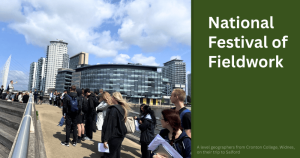
National Festival of Fieldwork
On the NFF page you will find lots of ideas and locations for you to consider when planning your own visits. Remember that even as adults we know that it is the ‘doing’ which can help us gain a deeper understanding of matters: for children the need ‘to do’ is even greater.
Happy planning!

Written by Paula Richardson
Paula Richardson is an author, education adviser and trustee of the GA, member of the Publications Board and Fieldwork and Outdoor Learning SIG (FOLSIG).
©Paula Richardson, and the Geographical Association, 2025


