
 Sign in

Photo of Whitby Abbey, England
1 September 2026
Read time: 5mins
‘I wanted to make something unmistakably from the United Kingdom.’
Ben Shackell
What drove me to build it?
This game came from my grandparents complaining that Wordle was in American English, so I wanted to make something unmistakably from the United Kingdom, celebrating all of our places, landmarks, towns and villages.
It has given my family a conversation starter and connection to each other from this brief daily game. So I wanted to share it. Please feel free to share it with anybody else who may enjoy it.
Once I started making it, I knew I did not want it to become a list of obscure facts. I wanted the clues to make you picture the place, or at least wonder what sort of place it might be. That is still the bit I enjoy most.
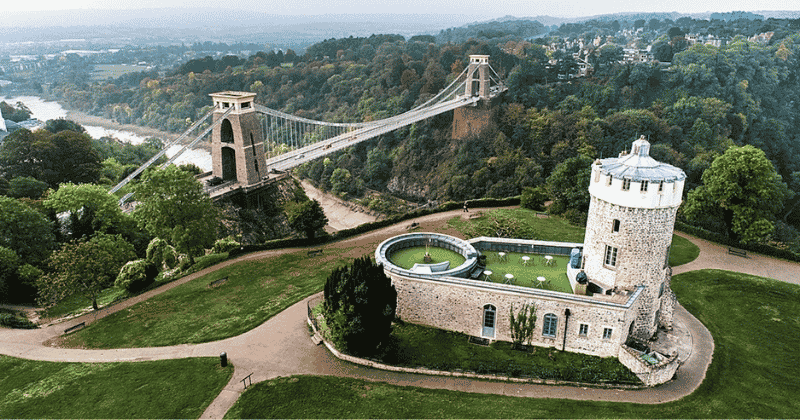
Clifton Suspension Bridge and the Observatory, Bristol. Photo: Chris Lathom-Sharp, CC BY-SA 4.0, Wikimedia Commons
Designing the clue rules
I did not write every clue in the game by hand. What I designed was the system behind them.
Each place gets four clues. The first should leave plenty of possibilities open. The next ones should narrow things down bit by bit, using the landscape, local character, history or a landmark. By the fourth clue, I want somebody with a reasonable knowledge of the UK to have a fair chance of getting it.
I use AI to help generate the clue sets within those rules. The AI is not deciding how the game works. I set the structure: what sort of information should appear at each stage, how quickly the answer should narrow, and the basic rule that a clue should make you picture somewhere rather than just remember a fact.
Bristol is a good example of how those rules work. Its four clues are:
Clue 1: Colourful houses climbing a hill
Clue 2: Harbourside walks and museums
Clue 3: Street art around corners
Clue 4: A suspension bridge spanning a dramatic gorge
The first clue could fit quite a few places. Once the harbour appears, the list gets shorter. Add the street art and Bristol starts to feel much more likely. The bridge almost gives it away.
I prefer that to simply asking, ‘Which city has the Clifton Suspension Bridge?’ You can take a chance early if you want, or hang on for another clue. Sometimes it confirms what you were thinking. Sometimes it sends you somewhere else.
What can you get from a clue?
Wells Next the Sea gives a very different sort of puzzle. Its clues mention beach huts through pine woods, boats sitting low in a harbour channel, salt marshes, and finally a Norfolk coastal town with a long walk to the sand.
You can still get something from those clues even if the name never comes to you. Boats sitting low makes you think about the tide. Salt marshes tell you something about the coast. Pine woods and a long walk to the sand start to build a picture. You might still be wrong, but you have somewhere to start.
When the answer comes up, there is a short fact as well. For Wells Next the Sea, it explains how medieval silting helped leave the harbour connected to open water by a long tidal channel. I like that the reveal gives you one more thing to take away. Quite often that is the bit that makes me look a place up afterwards.
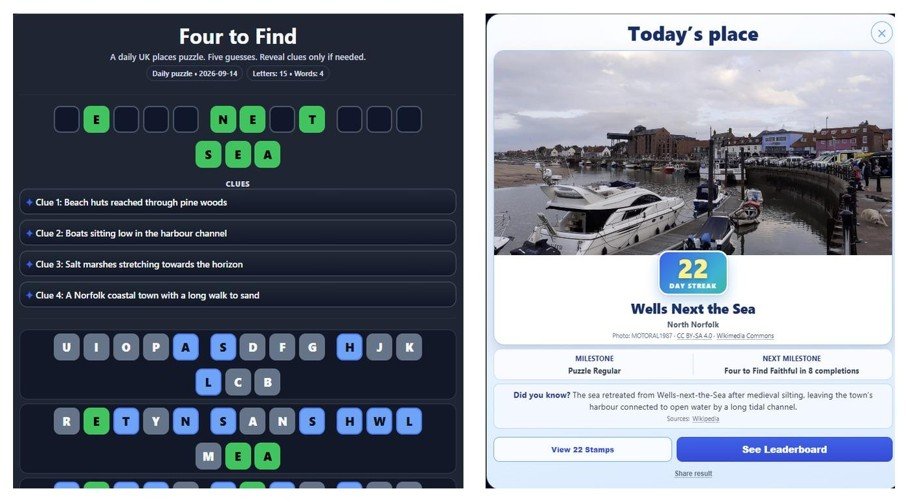
A puzzle in progress and the reveal for Wells Next the Sea. Screenshot supplied by the author; location photography is credited in the game where required
Why the places matter
What I like is that it is not only about whether you guessed the name. Sometimes you know the place straight away. Sometimes the name is familiar but, if somebody handed you a map, you would hesitate. And sometimes it is somewhere you have never really thought about before.
That is where the family part comes in. One answer reminds somebody of a holiday. Another brings up a school trip, or a town where a relative once lived. The game itself is brief. The conversation afterwards does not have to be.
I want it to move around the whole UK too, not just the obvious tourist places. A former industrial city can be as interesting as a small coastal town. So can a castle, an island or a village. There is plenty to choose from.
Getting a place you know is satisfying. Finding somewhere new can be just as good.
Could it work in a classroom?
I did not build Four to Find as a teaching resource. I studied physics, not geography education, and at first I was simply making something for my family. But I can see how it could work as a quick classroom starter.
Put clue one on the board and see what people say. Why Bristol? Why not somewhere else? What is the clue actually telling you? Then put up clue two and see who changes their mind.
When the answer is revealed, put it on a map. After that, there are lots of directions it could go in. One day that might be coasts. Another day it could be cities, transport, history or something completely different.
It does not need to become a whole lesson. Five minutes could be enough: argue for a place, change your mind, then see where it actually is.
Keeping it small
Four to Find is free and runs in your web browser. There is nothing to download. I have added streaks, a leaderboard and a stamp book because they make coming back each day more fun, but they are not the reason I made it.
I want the basic idea to stay small. One place each day. That is it. No endless feed and no reason to sit there for an hour. Play the place, have a chat if it brings something up, then come back tomorrow.
And getting it from clue one is not the only good result. You might remember somewhere you had forgotten, finally work out where a town sits on the map, or end up looking up one strange bit of local history afterwards. All of those count.
It began with my grandparents complaining that Wordle was in American English. Now it gives my family a small daily conversation starter and a reason to check in with each other. So I wanted to share it. Please feel free to share it with anybody else who may enjoy it.
Try Four to Find
Written by Ben Shackell who recently completed a Physics BSc at the University of Surrey. He created Four to Find because he wanted to make a daily game centred on places across the United Kingdom.
© Ben Shackell and The Geographical Association, 2026


