
 Sign in
26 November 2025
Read time: 6mins
‘Without coordinated action, key industries risk stalling at the very moment society needs them to tackle the environmental and infrastructural challenges ahead.’
Rob Parker and Tim Parker
Many of the UK’s critical industries that depend on geographersi and geoscientists are in the midst of a recruitment crisis. Yet today, more young people than ever are choosing geography at GCSE and A level, and record numbers are applying to geography-related degree programmes.
This should be a golden moment to celebrate the connection between classrooms and careers. Instead, it reveals a strange blockage in the talent pipeline: a generation more inspired than ever to address global challenges are not finding their way from geography classrooms into the careers where their skills could make the greatest difference. This could soon be geography’s greatest missed opportunity, as the decade brings a critical demographic tipping point and the talent pool of future geographers and geoscientists starts shrinking.
Without coordinated action, key industries risk stalling at the very moment society needs them to tackle the environmental and infrastructural challenges ahead. So how can we understand this challenge? And how can we work together to urgently address it?
Over the last decade, working with Time for Geography’s network of universities, employers and educational partners has enabled us to take a talent-pipeline perspective, from geography classrooms to early careers. Young people inspired by geography in school go on to make valuable contributions to society across a diverse range of fields and industries, with the uniting characteristic being interdisciplinarity: their ability to solve problems by bringing together the knowledge and skills of different fields across the sciences, humanities, technology and arts, underpinned by a systems approach to understanding the world at different scales of space and time.
Indeed, as AI accelerates routine analytical work, the skills that rise in value are the ones geography cultivates: connecting fields of knowledge, understanding systems, and shaping the right questions. But the pathways from secondary school geography to specific industry sectors are often not evident to students until far too late in their education:
- Schools: When parents at an options evening ask, ‘What can they do with Geography?’, even experienced teachers can struggle to translate that interdisciplinary strength into clear, recognisable career pathways. Other subjects provide definitive, one-word answers: law, medicine, engineering. In the heat of the moment, many of us are guilty of falling back on the vague, unhelpful misnomer internalised by generations of young people ‘You can do anything with geography’.
- Universities: The question then reaches academics at university open days, filled with students who enjoyed geography in school and are eager to take the subject further, but still asking where that enthusiasm actually leads. The problem at this point is that students are already making decisions that will shape their trajectory, without an informed understanding of the careers landscape. Soon, this lack of careers awareness is at play when making degree module choices, many of which are prerequisites that lock in module choices in future years.
- Employers: Employers across geography-related sectors report skills shortages, not for lack of enthusiasm from young people, but because too few graduates emerge with the specific training pathways these industries need. ‘Geographer’ is not a job title outside of education and academia, and many graduates only discover the technical or professional routes open to them when it’s too late to shape their degree choice and emphasis accordingly. By the time they apply for roles, many graduates and employers often wish they’d had the opportunity to exchange careers guidance years earlier.

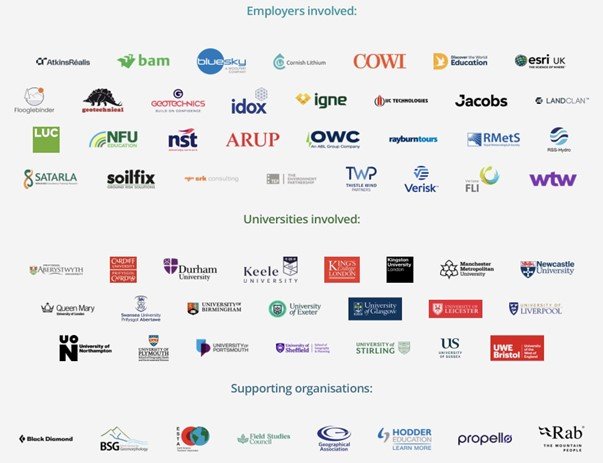
Addressing this challenge requires coordinated action across the talent pipeline of leading employers, universities and the secondary education community, to empower students with awareness of the geography careers landscape from the very start of their secondary education.
Time for Geography is now facilitating this through an Emergency intervention to repair and future-proof the geography-geoscience talent pipeline, designed to drive national-scale, long-term, systemic change in how young people see, understand and access geography-related careers. Delivered to the platform’s annual audience of several million geography students across UK and international schools, we are delighted to highlight the first outputs of this intervention for schools and universities:
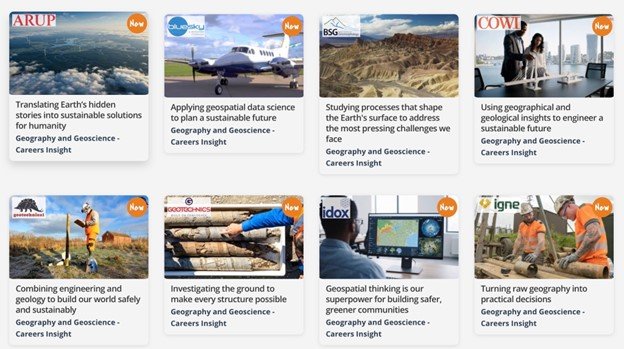
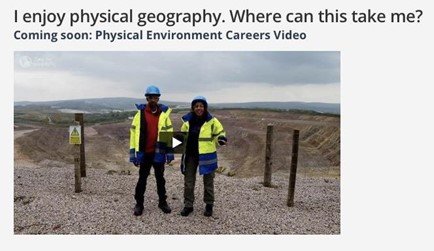
- Industry leaders in every geography classroom: We address the early awareness gap by giving students regular, classroom-level exposure to inspiring messages from geo-industry leaders. These bookend our Time for Geography videos as they are screened in thousands of classrooms every week, and sit within a Careers Video Collection emphasising the purpose of each pathway in addressing global challenges.

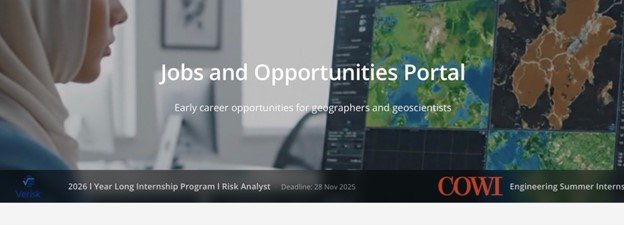
- Visible jobs for geographers: We tackle the invisibility of real jobs for geographers by giving young people direct sight of early-career opportunities long before they enter higher education. Major employers promote roles and training requirements through an Early Career Opportunities Portal, with live alerts across the platform, helping students understand the actual shape of the modern geography-related job market.

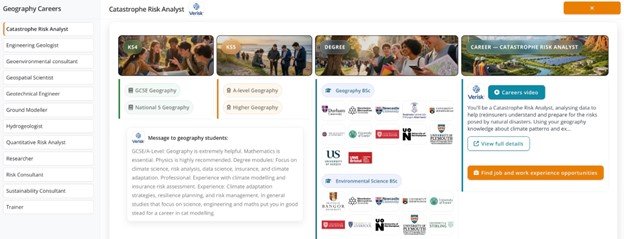
- Mapped pathways from classrooms to careers: We resolve the confusion around how subjects, courses and careers connect. Through the Geography Careers Explorer, employers and universities are working together to map every geography-related career pathway to every relevant degree programme, empowering students with a clear view of how choices in school and university lead to specific professional routes.
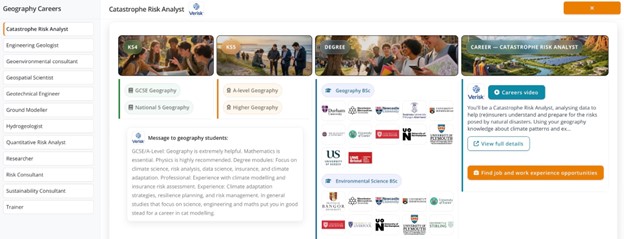
- Empowering geography teachers as careers champions: When students and parents ask ‘What can you do with geography?’ we need to advocate for our career-defining subject with conviction to rival the most applied of STEM disciplines. You can now do this using our Options and Open Days Pack.

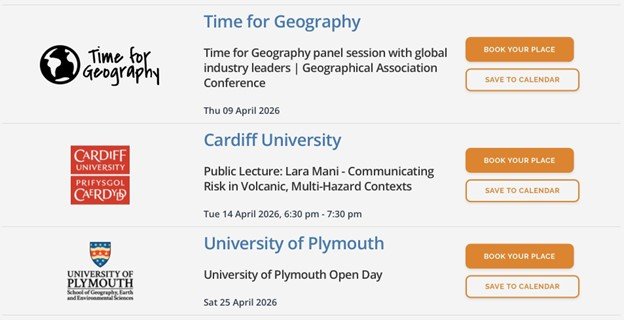
- Events and opportunities to engage: This initiative is supported by wider programmes of events and opportunities offered by Time for Geography and our community of partners. For conferences, open days, workshops, public lectures, CPD and careers events, visit the Geography and Geoscience Events Calendar.

For students and teachers: To stay up-to-date on this intervention and what it means for you, join our mailing list by signing up for a Time for Geography account here: https://timeforgeography.co.uk/accounts/signup/
For employers and universities: For information about how you can be involved in this initiative, please visit: https://timeforgeography.co.uk/partners/geoscience-talent-pipeline-intervention/
In secondary education we teach geography. At university level this broadens into a family of disciplines – geography, geoscience, Earth science, environmental science and related fields – which then diversify further across industry. Some colleagues understandably feel strongly about naming these distinctions. However, since geology is no longer offered in most schools, using multiple discipline names at this level risks adding confusion for the very learners we are trying to support. Thus, for the purposes of most of our work, ‘geography’ is used as the anchor term for the whole school-to-career family of pathways.


Written by Rob Parker (left) and Tim Parker (right), Founders of Time for Geography.
©Rob Parker, Tim Parker, and the Geographical Association, 2025


