
 Sign in
20 October 2025
Read time: 4mins
‘Geographical enquiry is not just a pedagogical tool; it’s part of the disciplinary knowledge of geography. It teaches students how geographical knowledge is constructed, tested, and revised.’
Lizzie Butler
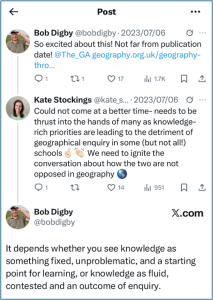
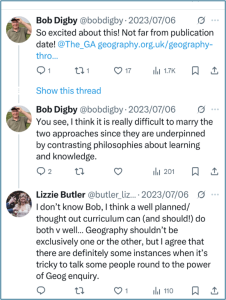
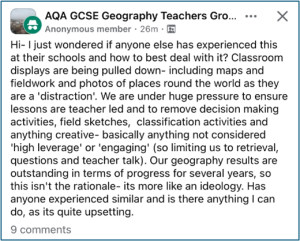
The images of social media posts above provide some context to the origins of this blog. Kate is right in her response to Bob’s original tweet about the publication of Margaret Roberts’ new book Geography Through Enquiry (second edition). ‘Knowledge-rich’ priorities are, to an extent – and in some schools – leading to the erasure of geographical enquiry from geography lessons. This is evidenced, albeit anecdotally, by a recent post on a Geography Teacher Support Group on Facebook.
But I’m going to (whispers behind hands) disagree with Bob Digby. I think it should be possible to marry the two within a high-quality geography curriculum, and I think not doing so is a disservice to our students.
Geographical enquiry is central to what it means to teach and learn geography well. It’s the beating heart of the discipline – the process through which students learn to ask questions, interrogate evidence, and make sense of the world. But in the current pedagogical climate, where explicit instruction and knowledge-rich curricula dominate, a tension has emerged.
Must departments choose between being true to the soul of geography or adopting teaching methods that help children learn knowledge effectively?
Let’s be clear: education is rightly becoming ever more research-driven and evidence-based. Direct instruction, coupled with regular opportunities for retrieval, is one of the most effective pedagogies for helping all students learn knowledge. This is not up for debate. But neither is the value of geographical enquiry. So why the false dichotomy?
Over the course of my career, I’ve seen lethal mutations of both approaches. Enquiry is often reduced to a vague, unstructured guessing game. Direct instruction devolves into silent drilling, with students chanting dense knowledge organisers without grasping meaning. Neither serves our students well.
Geographical enquiry is not just a pedagogical tool; it’s part of the disciplinary knowledge of geography. It teaches students how geographical knowledge is constructed, tested, and revised. It fosters critical thinking, analytical skills, and a sense of what it means to be a geographer. But – and this is crucial – you cannot enquire, or think critically, about that of which you have no knowledge. You cannot think deeply about something you don’t understand.
A curriculum that does both
Is it hard to do this well in a school geography curriculum? Possibly. But that’s no excuse not to try. If we don’t, we risk two equally damaging outcomes: either we deny students access to powerful knowledge about the world, or we fail to teach them how to think geographically.
To the knowledge-rich fundamentalists, we must point out that geographical enquiry is knowledge. As Ofsted (2021) puts it:
‘It is the disciplinary knowledge of how geographical knowledge originates and is revised. It is through disciplinary knowledge that pupils learn the practices of geographers.’
Therefore, enquiry must be taught within the context of a knowledge-rich curriculum. Students must be taught how to carry out geographical enquiry effectively – not left to flounder in the hope they’ll discover it themselves.
To the enquiry purists, we must challenge the conflation of enquiry with discovery-based learning. I recently saw a trainee teacher use a ‘diagrams from memory’ activity to teach meander and oxbow lake formation. Students took turns memorising and recreating a complex diagram. This, of course, is neither geographical enquiry nor effective geography teaching. ‘Why not just tell them?’ I asked. Let them learn the facts first – clearly, accurately, and efficiently – and then use that knowledge to enquire meaningfully.
By all means, let’s follow Margaret Roberts’ enquiry process: start a unit with a big enquiry question and spend some time generating a need to know. But then, explicitly, directly, and expertly teach the knowledge that students need for them to be able to ‘think geographically’ about it and reflect on their learning.
Or, once you have spent a unit of work explicitly, directly, and expertly teaching students the knowledge they need, round the unit off with a mini two-lesson enquiry for students to use their acquired knowledge to answer a ‘big question’.
Conclusion
Knowledge and enquiry are not enemies. They are partners. One provides the foundation; the other builds upon it. A robust geography curriculum must do both – teach powerful knowledge and cultivate the skills to question it. Anything less is a disservice to our students and to the discipline itself.
Interestingly, research in this space has already been carried out in the scientific community:
‘Experts in teaching science recommend that scientific reasoning be taught in the context of rich subject matter knowledge. A committee of prominent science educators, brought together by the National Research Council put it plainly: “Teaching content alone is not likely to lead to proficiency in science, nor is engaging in inquiry experiences devoid of meaningful science content.” The committee drew this conclusion based on evidence that background knowledge is necessary to engage in scientific thinking.’ – Willingham, 2008
Is the same not true of geography? I would like to see the GA or researchers in the geography education space try to find out…
References
- Daniel T. Willingham (2008) Critical Thinking: Why Is It So Hard to Teach? Arts Education Policy Review, 109:4, 21-32. https://doi.org/10.3200/AEPR.109.4.21-32.
- Department for Education (2021). Research review series: geography.

Written by Lizzie Butler, Humanities Curriculum Improvement Lead at GLF Schools
©Lizzie Butler, and the Geographical Association, 2025


